Showing posts with label UNHCR. Show all posts

Tuesday, October 30, 2012

#Myanmar fighting kills 84, displaces at least 22,500

By the CNN Wire Staff
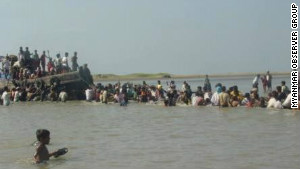
People have been displaced across Rahkine state in western Myanmar.
Some fled from the violence by boat
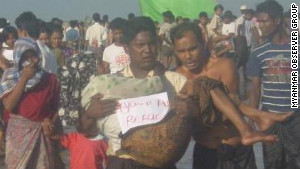
Hong Kong (CNN) -- The death toll from fighting between Buddhists and Rohingya Muslims in western Myanmar last week has risen to 84 and at least 22,500 people have been displaced by the sectarian violence, state media and the United Nations say.
The state-run New Light of Myanmar newspaper said on Monday that 129 people were also injured during the violence, which erupted on October 21 and has cast a pall over recent reforms in the Asian nation.
However, the paper added that no new clashes had been reported since Sunday and the areas affected had returned to "normalcy."
Following a visit to five townships where the fighting took place, Ashok Nigam, the U.N. humanitarian coordinator for Myanmar, on Sunday said his team had seen "large-scale" destruction of houses and the displaced were in urgent need of humanitarian assistance.
The swath of arson, the group said, stretched over 35 acres and included houseboats and floating barges. It added that local police shot at Muslims trying to put out the fires.
Phil Robertson, deputy Asia director of Human Rights Watch, said the government in Myanmar has done little to address the root causes of the violence and the discriminatory treatment that many Rohingya face.
"Extremists in both communities have been empowered by a lack of accountability where people involved in sectarian violence haven't been bought to justice so it's a very, very bad situation and one that is getting worse," he told CNN.
The Rohingya are a stateless Muslim minority who say they have been persecuted by the Myanmar military during its decades of authoritarian rule. Myanmar doesn't recognize them as citizens.
Unrest between the Rohingya and majority Buddhists has tested President Thein Sein's administration, which is trying to seek reconciliation with Myanmar's different ethnic groups and move the country toward more democratic governance.
The government has sent extra security into the troubled region and declared a state of emergency. The president's office warned Thursday that "manipulators" behind the violence can expect to be found and prosecuted.
Opposition leader Aung San Suu Kyi, speaking in Parliament on Friday, called for a greater security presence and urged authorities to investigate suspected human rights offenses.

Wednesday, October 10, 2012

Plight of #stateless #Rohingyas hinges on #citizenship: #US official

The lack of citizenship must be addressed for any long-term solution to the distress in the Rohingya community to occur, a top US refugee official said on Tuesday.


Conditions are rough in Teknaf camp in Bangladesh. Movement of refugees is restricted and housing is in need of repair or renewal. Photo: UNHCR
Conditions are rough in Teknaf camp in Bangladesh. Movement of refugees is restricted and housing is in need of repair or renewal. Photo: UNHCR 
Kelly Clements, a US deputy assistant secretary of the Bureau of Population, Refugees, and Migration, spoke to the Open Society Foundation and Refugees International in Washington, DC, on the Rohingya issue.

In a transcript of his talk, released on Wednesday, he said citizenship is a core concept that defines the relationship between a state and an individual – each has obligations to the other.

“Citizenship is often the gateway to a person’s ability to realize a range of human rights and basic services, including freedom of movement, freedom from discrimination, arbitrary arrest and detention, the right to vote, access to education, and property ownership,” he said.

The former Chief Justice of the US Supreme Court, Earl Warren, described citizenship as “the right to have rights,” he said.

For this reason, stateless persons are vulnerable to abuse and exploitation, including gender-based violence, trafficking in persons, and arbitrary arrest and detention, he said.

“Combating statelessness requires first that governments, civil society groups, and international, regional, and local organizations recognize the problem, its causes, and the suffering and indignities it inflicts on millions of people around the world,” he said, calling it an under-recognized issue.

He said the US is the single largest donor to the UN commission of refugees, contributing over $775 million to UNHCR’s work on protection, assistance and statelessness this year.

“The Rohingya’s ethnic identity and origin are highly disputed,” he said. “While some historical accounts note that they are indigenous to the kingdom of Arakan since the 9th century, which at times, also occupied southern parts of modern Bangladesh; others claim that Rohingya migrated to the region during British colonialism. This latter claim has consistently fueled anti-Rohingya sentiment, leading to periodic tension and violence against the Rohingya by the former military regime after Burma gained independence.”

He said approximately 800,000 stateless Rohingya live in a region that has experienced significant displacement and periodic violence over decades.

“Much needs to be done: to reduce tensions, to improve the humanitarian situation, and to work towards a sustainable and just solution for all those who have suffered from the conflict and longer-term deprivation of rights,” he said.

“Some of the tough issues to be addressed include lasting security and stability, freedom of movement for Rakhine and Rohingya, protection (and when I say protection, including the provision of physical security and basic rights), and unimpeded humanitarian access and assistance to meet basic immediate needs.”

He said that at the same time as the Burmese government works to address the underlying causes of ethnic conflict, “We believe a regional approach is necessary to address mixed flows of refugees and migrants by land and sea and ensure that those fleeing are treated humanely.”

He said, “Sadly, solutions to this protracted displacement appear increasingly elusive. I noticed a definite increase in tension and desperation since my last trip in 2011, and an escalation in humanitarian need. School enrollment is down as parents pull children from classes to become income earners, and malnutrition rates exceed emergency levels and continue to rise. Unfortunately, at the same time, organizations are facing greater obstacles to help ameliorate the situation.

“In our field visits to the official camps, refugees demonstrated for the right to nationality, highlighted human rights violations, and advocated for more services and education for their children. Outside the camps, the undocumented Rohingya population suffers even more without access to school, health care or decent shelter,” he said.

He said the US would continue to work to organize an effective plan to address the Rohingya issue involving Burma, Bangladesh and the international community.

Source 

Monday, September 10, 2012

No Rohingyas IDPs camps in northern Arakan

Maungdaw, Arakan State:  The concerned authority of Maungdaw are not allowing any camps for Internal Displace peoples (IDPs) of Rohingyas who lost their homes and property in recent riot which occurred in June, according to an elder from Maungdaw.
“300 families from Maung Nah ( Sa OH Brang) village of Buthidaung township was uprooted  by security forces  and looted all their property. The security forces drove out the Rohingya families from the area to Maungdaw. But, the Burma border security force (Nasaka) again drove out them to the Buthidaung. Now, the Rohingyas families are staying at Nan Yah Gone (Mein Gee Si) village without any home as the security forces are not allowing them to enter to their village. The Rohingyas become IDPs in their own land. No authority is going to build for them temporary accommodations.”
Similarly, Rohingyas from Rathedaung township move to Maungdaw south, staying in the jungle or village under the trees  since last month. No accommodations are made for them by authority of Maungdaw. These Rohingyas are not able to stay in their villages of Rathedaung for their security. Rakhine community from Rathedaung are always trying to attack the Rohingyas community.The security personnel- police, Nasaka, Hluntin and army are not giving protection  to them. So, the Rohingyas left their home town  to Maungdaw where they have  no accommodations to live or temporary tents for them, said a village admin officer from Maungdaw south.
The governmental team led by Union Minister for Ministry of Border Affairs accompanied by representatives of UN Agencies and INGOs had made the field trips to Arakan State for three times, having access for the humanitarian assistance to the affected persons from both communities – Rohingya and Rakhine.
The delegations main purpose of visiting is for restoration of peace and stability and to provide the emergency relief for the affected persons of both communities as first trip on 13- 17 June and the group again visited Arakan on 27- 29 June for sustaining of relief campaign and promoting to resettlement stage, establishing and imitating the resettlement plan for the affected persons with Coordination on  Humanitarian Assistance  from the International communities and progressing the resettlement campaign, normalization initiatives between the community on 16-18 July as last visiting the area, according to Access to the Humanitarian Assistance report of U Thein Sein government.
But, U Thein Sein government didn’t provide any assistance to Rohingyas from northern Arakan and only provided to Rakhine who are not most effected than Rohingyas in northern Arakan. The authority is showing the new settler ( Natala ) villagers who were settled on Rohingya lands by government. How many family effected in the recent riot? There are only 222 shelters and 400 tents from UNHCR while 128 shelters from CARE. Where is shelther for Rohingyas who are IDPS from Maungdaw, Buthidaung and Rathedaung, The reliefs goods also for only Rakhine community  from northern Arakan , not for Rohingyas, Why, is the Rohingyas are not  including in UN categories  to get relifs? Now , again, the authority is creating new IDPs – hill people, Maungdaw north Rakhine and outside of northern Arakan – along the roadside of Maungdaw Aley Than Kyaw highway with UNHCR provide tents, according to a school teacher from Maungdaw.
“Two load trucks of Rakhine from Maungdaw north arrived at Young Chang village where they started looting and stealing animals from Rohingya community of Young Chaung. The security force are not charging any action against them.”
“The UN and INGos are only providing  relief goods to Akyab of Rohingyas and what about other side of Rohingyas who are living in Mrauk-U, Minbya, Kyauktaw, Paucktaw and Kyauknimaw. No, INGOs or UN didn’t visit this place to look after for these Rohingyas.”
In Maungdaw, Rohingyas who lost their home in the recent riot, are living beside of the Rohingyas’ home and they are not getting any help from any quarters.  Most of Rohingyas in Maungdaw are going starvation for shortage of foods, Most Rohingya who are working as a day labors effected more, said an elder from Maungdaw.

Source

Wednesday, August 22, 2012

Myanmar releases more aid workers


iol pic wld  Indonesia Myanmar Rohingya
AP
Muslim protesters hold a banner during a rally calling for an end to the violence against ethnic Rohingya in Rakhine State of Myanmar, in Jakarta, Indonesia.
Geneva -
Officials say Myanmar has released at least six of the 12 international aid workers detained over the summer amid an ethnic conflict.
The 12 aid workers are employed by Doctors Without Borders, the U.N. refugee agency and the World Food Program. They have been held since June by Myanmar authorities in Rakhine state, an area of western Myanmar where a state of emergency was declared because of ethnic clashes.
The groups gave few details about their cases, and it wasn't clear when or how the six have been freed.
Doctors Without Borders said Wednesday that four of its six detained staff members were released. The U.N. refugee agency said two of four Myanmar nationals on its staff were released.
The World Food Program gave no details about its aid workers. - Sapa-AP

Monday, August 20, 2012

Rohingyas treated as collateral damage


Violence against Myanmar’s Muslim minority is only the latest chapter in a history of state-sponsored repression that began in the 1950s in a bid to achieve racial purity
  • By Azad Essa
  • Published: 00:00 August 18, 2012
A few weeks ago, a picture showing hundreds of dark-skinned men splayed across a beach was passed around on Facebook. The men appeared to be either asleep, or more likely, dead. They lay against each other, their faces averted from the camera, while men in fatigues holding semi-automatic weapons towered over them. The caption read: ‘Continuity of massacre of Muslims of Myanmar by Buddhists. More than 1,000 killed yesterday. Please share.’
After some probing, the photograph turned out to be a fake. But all fabrications aside, there actually is a bona fide crisis unfolding along the Myanmar and Bangladesh border — despite the poppycock on social media, the sham did raise questions that traditional media have largely ignored.
Violence between Buddhists and Rohingya Muslims in Myanmar’s Rakhine region erupted in June after the alleged rape and murder of a Buddhist girl by Muslim men. The scale of violence has led to scores of deaths and the mass displacement of tens of thousands of people.
After a state of emergency was declared in the province, the entry of Myanmar’s security forces lent another dimension to this conflict. Amnesty International said in early August that Rakhine Buddhists, together with security forces, purposefully meted out devastating violence against the Muslim minority.
But not only are the Rohingyas a disenfranchised people, they are dark-skinned Muslims with little relevance, representation and significance to anyone. Unable to deal with a matter the much-vaunted Nobel peace laureate Aung San Suu Kyi has not endorsed, the western world has tiptoed around the issue.
Suu Kyi’s silence is evidently an attempt to placate her constituency ahead of general elections in 2015, and to criticise her now would be like admonishing Nelson Mandela in the run-up to the 1994 election in South Africa. But unlike South Africa in the 1990s, Myanmar is not on the verge of some tremendous political shakeup; while the Rohingyas are being sacrificed as collateral damage in the greater project of the democratisation of Myanmar, Suu Kyi is missing an extraordinary opportunity to live up to her reputation.
Delayed reaction
Meanwhile, in that parallel universe known as the ‘Muslim world’, the Rohingyas have joined Palestine, Kashmir, Iraq and Afghanistan on the list of flagship Muslim causes. In a region that is home to the world’s greatest concentration of Muslims, the delayed reaction of neighbouring Indonesia, Malaysia and Brunei is startling.
Last week, Bangladesh, another Muslim country, ordered three NGOs to stop providing food and other humanitarian assistance to Rohingyas in the border area, claiming it did not want to encourage more asylum-seekers to its shores. Already 40,000 unregistered Rohingyas live in makeshift camps in Bangladesh, and according to the UN Refugee Agency, the latest violence will result in a greater influx of people — whether Bangladesh likes it or not.
While Myanmar’s Muslim neighbours struggle to respond, Saudi Arabia has donated money. It has fallen to Turkey to act decisively by further extending its newly found benevolence to the Islamic world. As images of the Turkish prime minister’s wife sobbing as she witnessed the effects of the violence herself begin to be passed around online — further cementing the Rohingya cause to the long list of Muslims’ suffering — Muslim prayers have bemoaned the global silence. And yet little is being done by Muslims to actually reverse the treatment of their purported brethren themselves.
It all makes for a rather disempowering picture, but it doesn’t have to. Given how fast a fake picture can spread its way across the world, imagine what we could do with a little engagement.
— Guardian News & Media Ltd
Azad Essa is a journalist and the author of Zuma’s Bastard and The Moslems are Coming.

Friday, August 10, 2012

Rohingya Muslims face severest discrimination: US Report

 Washington:
The constitution, laws and policies in Myanmar (formerly Burma) restrict religious freedom and Rohingyas Muslims face ‘severest’ form of discrimination and restrictions including on access to education and health, a US report on the state of religious freedom said.
Released last week, the annual International Religious Freedom Report 2011 noted that Muslims across Myanmar, as well as ethnic Chinese and Indians, often were required to obtain permission from township authorities to leave their hometowns. Authorities often denied Rohingya and other Muslims living in Rakhine State permission to travel for any purpose, the report says.
However, it adds, permission was sometimes obtained through bribery. Muslims in other regions were granted more freedom to travel, but still faced restrictions. For example, Rohingyas living in Rangoon needed permission from immigration authorities to travel into and out of Rakhine State.

“Muslims in Rakhine State, particularly those of the Rohingya minority group, continued to experience the severest forms of legal, economic, educational, and social discrimination,” the State Department report said, documenting the plight of Rohingya Muslims during last year. There were reports that Buddhist physicians would not provide Muslims the endorsement required by the Ministry of Health that permits Muslims to travel outside Rakhine State to seek advanced medical treatment.

The government denied citizenship status to Rohingyas, claiming that their ancestors did not reside in the country at the start of British colonial rule, as the 1982 citizenship law required. The Rohingyas asserted that their presence in the area predates the British arrival by several centuries. In November 2008 the UN Committee on the Elimination of Discrimination Against Women urged the government to review its citizenship law.
In February 2010 the UN Special Rapporteur on the situation of human rights in Myanmar visited the country and noted discrimination against Muslims. Many of the approximately 28,500 Rohingya Muslims registered in two refugee camps in Bangladesh and the estimated 200,000 Rohingya Muslims living outside those camps, also in Bangladesh, refused to return to the country because they feared human rights abuses, including religious persecution.

Essentially treated as illegal foreigners, Rohingyas were not issued Foreigner Registration Cards (FRCs). Since they also were not generally eligible for NRCs, Rohingyas have been commonly referred to as ‘stateless’.
In the run-up to national elections in November 2010, the government issued Temporary Registration Cards (TRCs) to residents in northern Rakhine State; the majority of them are Rohingyas. The issuance of TRCs was primarily done, it appears, to allow Rohingyas participation in the elections.
The United Nations High Commissioner for Refugees (UNHCR) worked with approximately 750,000 residents of Rakhine State who did not hold citizenship in the country. At the end of the reporting period, the UNHCR (quoting government estimates) indicated that 85 percent of eligible residents (637,500 stateless persons) over the age of 10 possessed TRCs.
 
The UNHCR noted that according to information from individuals in northern Rakhine State, many individuals issued TRCs were actually only given a TRC number and no document. The UNHCR also assisted Rohingyas with education, health, infrastructure, water and sanitation, and agriculture.
 
Without citizenship status Rohingyas did not have access to secondary education in state-run schools. Those Muslim students from Rakhine State who completed high school were not permitted to travel outside the state to attend college or university.
During the period covered by the 2011 report, the document also makes note of the government’s implementation of considerable political reforms, but says it did not demonstrate a trend toward either improvement or deterioration in respect for and protection of the right to religious freedom.
The government maintained restrictions on certain religious activities and limited freedom of religion, although it generally permitted adherents of government-registered religious groups to worship as they chose.

Authorities continued to bar Muslim university students who did not possess NRCs from graduating. These students were permitted to attend classes and sit for examinations, but they could not receive diplomas unless they claimed a foreign ethnic minority affiliation.
Rohingyas also were unable to obtain employment in any civil service positions. Rohingya couples needed also to obtain government permission to marry and faced restrictions on the number of children they could have. Muslim newcomers were not allowed to buy property or reside in Thandwe, Rakhine State, and authorities prevented Muslims from living in the state’s Gwa or Taungup areas.

The government continued to monitor Muslim activities closely. Restrictions on worship for other non-Buddhist minority groups also continued. Although there were no new reports of forced conversions of non-Buddhists, authorities in some cases influenced the placement of orphans and homeless youth, preferring Buddhist monasteries to Christian orphanages.
Adherence or conversion to Buddhism was an unwritten prerequisite for promotion to most senior government and military ranks. Nearly all senior level officers of the ruling Union Solidarity and Development Party (USDP) and the armed forces are Buddhists.

There were reports of societal abuses or discrimination based on religious affiliation, belief, or practice. During the year, social tensions continued between the Buddhist majority and the Christian and Muslim minorities.
 
According to the report, widespread prejudice existed against citizens of South Asian origin, many of whom are Muslims. The government continued to refuse to recognize the Muslim Rohingya ethnic minority as citizens and imposed restrictions on their movement and marriage.
Antidiscrimination laws do not apply to ethnic groups not formally recognized under the 1982 Citizenship Law, such as the Muslim Rohingyas in northern Rakhine State.
There were reports of abuses of religious freedom, including the continued detention and incarceration of Buddhist monks throughout the country, the arrest of Muslims in the broader Rangoon area for unauthorized teaching as well as praying in living quarters, and the interrogation and harassment of Baptists in Kachin State.

The government selectively enforced legal restrictions on religious freedom. Religious organizations were subject to restrictions on freedom of expression and association.
The government’s pervasive internal security apparatus imposed implicit restrictions on collective and individual worship through infiltrating and monitoring meetings and activities of virtually all organizations.
In practice, authorities restricted the quantity of imported Bibles and Qur’ans, although individuals continued to bring them into the country in small quantities for personal use.
Government censors continued to enforce restrictions on local publication of the Bible, Qur’an, and other Christian and Islamic texts.
 

International community press solution for Rohingyas


International community press solution for Rohingyas

During the past two decades, Bangladesh accepted and sheltered more than 300,000 Rohingya refugees, who not only stayed back but also put heavy economic and social burden on the world's most densely-populated nation.
After violence erupted in the Rakhine state in early June, Bangladesh refused giving shelter to any Rohingya. Although the refusal drew criticism from human rights activists, it has attracted the attention of the international community to the Rohingya issue.
It is worthwhile to note that the 57-member Organization of Islamic Cooperation (OIC) has launched a major international campaign to put an end to the ethnic cleansing of the Rohingya Muslim minority in the Rakhine state of Myanmar and protect their legitimate rights. OIC offices in Geneva, New York, and Brussels are making intense efforts to foster international intervention in the issue.
The OIC is believed to be in touch with the United Nations, UN Human Rights Council, European Union and other international organisations to halt the humanitarian crisis in Myanmar.
OIC Secretary-General Ekmeledin Ihsanoglu strongly condemned the situation which has resulted in deaths of innocent civilians, burning of their homes and forced eviction from their homeland. Ihsanoglu further hoped that the Myanmar government would respond to the concerns of the international community in a positive and constructive manner, so that all its Rohingya Muslims are able to return to their homeland with honour, safety and dignity.
Furthermore, the issue was raised at the recent Asean Foreign Ministers' meeting in Cambodia. The Asean is seeking an explanation from member state Myanmar about recent ethnic violence targeting minority Rohingya group. "There will be a full explanation from Myanmar because this is an important and critical issue for Asean as a community," Asean Secretary General Dr. Surin Pitsuwan reportedly said.
On July 28, it was reported that the UN High Commissioner for Human Rights, Judge Navi Pillay, called for an independent investigation following claims of abuses toward Rohingyas by security forces in Myanmar.
On July 25, Aung San Suu Kyi called for new laws to protect Myanmar's ethnic minority groups, highlighting one of the country's most challenging issues as it opens up to the outside world.
She urged the government to pass "necessary laws or amend laws to protect the rights of ethnic nationalities," and said protecting minority rights required more than just maintaining ethnic languages and cultures. "The high poverty rates in ethnic states clearly indicate that development in ethnic regions is not satisfactory and ethnic conflicts in these regions have not ceased," she said. She didn't, however, mention the recent violence in the Rohingya area.
Ms. Suu Kyi called for an end to discrimination against ethnic minorities as part of the "emergence of a genuine democratic country," the Associated Press reported. By focusing on the country's ethnic divisions in her first parliamentary address, Ms. Suu Kyi rightly drew attention to an issue that needs to be resolved speedily and peacefully.
While, in May, Suu Kyi met thousands of Myanmar refugees at a Thai border camp and promised to try as much as she could to help them return home, she was conspicuously silent on the Rohingya issue. During the recent trip to Europe, she talked about need for "the rule of the law" in the country and avoided the Rohingya issue, which disappointed many human rights organisations overseas.
Human-rights groups, meanwhile, have criticised Ms. Suu Kyi for failing to speak out more in favour of the Rohingyas, whom most people in Myanmar consider "illegal settlers" in Myanmar.
In mid-July, Myanmar's president told the UN High Commissioner for Refugees Antonio Guterres: "We will take responsibility for our ethnic people but it is impossible to accept the illegally entered Rohingyas, who are not our ethnicity," according to the president's official website. However, the UN high commissioner reportedly did not agree with the views of the president on the Rohingya issue.
Since its independence, Myanmar has suffered from intense ethnic divides. More than a half-dozen ethnic groups claim autonomy from the centralised government system dominated by the Burman ethnic group.
At least one group, the Kachin, is waging a low-level war against the government, while violence in western Myanmar in early June between Buddhists and Muslim Rohingyas in Rakhine state (Arakan) left at least 78 people dead and led to the declaration of emergency in the state by the government.
The administration of President Thein Sein is to be credited as it has reached cease-fire deals with some restive minority groups, but peace with the Kachin has yet to take place. Many analysts say more radical changes are needed, including enactment of new laws to recognise the ethnicity of minorities in Myanmar.
It is important to note that many of the groups occupy areas crucial for the country's economic plans because they are home to large portions of Myanmar's rich natural resources, including natural gas and mined commodities.
Although Myanmar authorities have focused recently on trying to steer more economic development into ethnic areas, many investors remain wary of sinking money into regions where conflicts could flare up. The Rohingya conflict, in particular, has reportedly unnerved investors and upset rights advocates who fear the violence could escalate and destabilise Myanmar.
Myanmar will chair Asean in 2014 and, given that perspective, analysts say the Myanmar government needs to sit down for a dialogue with all ethnic groups including Rohingyas to grant equal rights and autonomy in Myanmar's political system. The deal with the ethnic groups in the late '40s (so-called Panglong Agreement) collapsed after late General Ne Win took power in a 1962 coup.
The writer is former Bangladesh Ambassador to the UN, Geneva.

Thursday, August 9, 2012

The President, the Lady, and the Plight of the Rohingya

Aug 2, 2012


© 2012 by the Center for Strategic and International Studies. All rights reserved.


Myanmar continues to pursue reforms at an impressive pace, but the plight of the country’s Rohingya population remains a disgrace for a state seeking to engage the international community. That disgrace is not the government’s alone—it is shared by the opposition movement, including its leader Aung San Suu Kyi as well as the country’s neighbors and the international community.
The more than 800,000 Rohingyas that live in Myanmar today, most in western Rakhine state, are denied citizenship by the government and face a range of abuses including forced labor, marriage restrictions, and unlawful detention. Their suffering is so severe that many have sought refuge across the border in Bangladesh, while others have fled on dangerous voyages by boat to Thailand and Malaysia. Amnesty International July 20 noted that both security forces and Buddhists in Rakhine state have been carrying out “primarily one-sided” attacks, including massive security sweeps, detentions, and killings, against the Rohingya in the weeks after a wave of communal violence erupted between the area’s Buddhist and Muslim populations.
During the recent communal violence, the country’s news outlets engaged in base fear-mongering, equating Rohingyas with “terrorists,” and the government did nothing to dispel these assertions. Officials and most commentators from Myanmar’s majority Burman ethnic group insisted that the Rohingyas are recent migrants from Bangladesh and do not qualify as one of the country’s roughly 135 ethnic minorities. Immigration Minister Khin Yi said this week that they will not be included in the country’s 2014 census. Popular Myanmar News Journal has reported that he told Bangladesh’s ambassador to Myanmar that Rohingyas are not citizens because they only began migrating to the country after 1824.
The impossible situation in which Rohingyas find themselves has been on display since the eruption of violence nearly two months ago. Many have attempted to flee to Bangladesh with their families, where they have been stopped at the border and refused entry. Those who made it across the border face detention and deportation back to Rakhine state. Myanmar’s president Thein Sein announced that only those Rohingyas with proof of citizenship would be permitted to return to their homes, but the government has long denied Rohingyas the right to legal documentation of any kind. The president said Myanmar will not accept “illegal immigrants” and has requested that the United Nations refugee agency either place the Rohingya in refugee camps or deport them to a third country, which the UN understandably refused.
On the opposition side, the widely respected Aung San Suu Kyi has avoided the subject. During her June trip to Europe, which coincided with the outbreak of communal violence in Rakhine state, she said only that the country must clarify its citizenship laws. Whether such clarification would embrace or dispossess the Rohingya was left unclear. In her first parliamentary speech July 25, Suu Kyi spoke of soaring poverty rates and other roots of violence in “ethnic states,” but did not mention the deadly violence in Rakhine state or the government’s treatment of Rohingyas. Other leaders of her National League for Democracy have made clear that they are of one mind with the government in declaring the Rohingya squatters on their own land.
Some international commentators argue that the opposition’s position is to be expected since the issue is politically sensitive and most citizens hold extremely hostile views toward the Rohingya. But that is no excuse for silence in the face of killing, rape, and abuse of a helpless people. Some have argued that Suu Kyi herself has her arms tied now that she is an elected member of parliament from a conservative district. This wildly underestimates the influence of “the Lady.” Suu Kyi is much more than a parliamentary opposition leader; she is the scion of the nation’s greatest hero, the symbol of resistance to what was until recently one of the world’s most repressive regimes, and to many of her countrymen a bodhisattva, one on the path to enlightenment and Buddhahood.
The government of Myanmar needs to snap out of its denial and confront the Rohingya issue head on. The nearly million Rohingyas in Myanmar are the country’s responsibility, and proper rights must be accorded to
them. President Thein Sein should also have a frank and practical discussion about repatriation issues with his Bangladeshi counterpart during his upcoming visit to Dhaka.
Aung San Suu Kyi must break her silence on the issue. She cannot change the collective opinions of an entire country over night, but her voice is critical in getting the ball rolling. Even if the government tomorrow decreed the Rohingya citizens of Myanmar, most of the population would still see them as intruders. Only Suu Kyi’s opinion can carry enough weight with the Burman majority to make a dent in that prejudice.
The international community also should play a stronger role. It is encouraging that ASEAN secretary-general Surin Pitsuwan has taken a “personal interest” in the issue and spoke directly to Myanmar and Bangladesh during ASEAN meetings in Cambodia in July. However, the organization and its member states can do much more to facilitate a solution. A good opportunity will be at an upcoming international conference on the Rohingya in August, where progress can hopefully be made toward allowing access for aid that is currently being blocked by the government. The conference was announced by the Malaysian International Islamic Cooperation Institute, but the exact location remains undecided.
Other concerned actors ranging from the United States to the Organization of Islamic Conference (OIC) should also hold Myanmar’s feet to the fire on this issue since it remains an enormous blemish on the country’s path to reform. The United States and Europe have spent decades condemning the treatment of the country’s other minorities, particularly the Karen and, more recently, the Kachin. Their response to the plight of the Rohingya has been, by comparison, remarkably muted. At the very least, they should support the call by the United Nations High Commissioner for Human Rights for an international inquiry into the widely reported abuses against the Rohingya by security forces in Rakhine state.
UN special rapporteur on human rights for Myanmar Tomas Ojea Quintana traveled to Rakhine state this week to assess the situation. He was told dismissively by Immigration Minister Khin Yi that “this is just a regional but not an international issue . . . so I don’t think the government will accept the call to open an inquiry as if this were an international issue.” The international community must make clear that the problem will not simply go away. The plight of the Rohingya may well constitute crimes against humanity, according to a June report by respected researchers at the Irish Center for Human Rights. Myanmar’s civilian government, its democratic opposition, the country’s neighbors, and the global community all have an obligation to confront this reality and ensure that it is rectified. (This Commentary first appeared in the August 2, 2012, issue of Southeast Asia from the Corner of 18th and K Streets.)
Gregory Poling is a research associate with the Southeast Asia Program at the Center for Strategic and International Studies (CSIS) in Washington, D.C. Prashanth Parameswaran is a researcher with the CSIS Southeast Asia Program.

Commentary is produced by the Center for Strategic and International Studies (CSIS), a private, tax-exempt institution focusing on international public policy issues. Its research is nonpartisan and nonproprietary. CSIS does not take specific policy positions. Accordingly, all views, positions, and conclusions expressed in this publication should be understood to be solely those of the author(s).
© 2012 by the Center for Strategic and International Studies. All rights reserved.

'Mass graves' for Myanmar's Rohingya

A freelance reporter contributed this report to Al Jazeera from Myanmar. He is not being named for his own safety. 

A recent journey to western Myanmar has revealed a provincial capital divided by hatred and thousands of its Muslim residents terrorised by what they say is a state-sponsored campaign to segregate the population along ethno-sectarian lines.

Decades-old tension between ethnic Rakhine Buddhists and Rohingya Muslims in coastal Rakhine state exploded with new ferocity in June, leaving at least 78 people dead and tens of thousands homeless.

Exclusive reporting conducted last week in the highly restricted region suggests that the long-term fallout from recent violence could be even more damaging than the bloodshed.

The United Nations has estimated that 80,000 people are still displaced around the cities of Sittwe and Maungdaw, and international rights groups continue to denounced Myanmar for its role in the conflict.

As it stands, any thought of reconciliation between local Buddhists and Muslims appears a distant dream.

Many Rohingya have fled the polarised region, fearing revenge attacks and increasing discrimination. Their status has sparked international concern and disagreement.

Rights groups have condemned the violence. The Myanmar government has denied any wrongdoing, while neighbouring Bangladesh has rejected an influx of refugees and slashed access to aid.

For those Rohingya caught up in the dispute, the day-to-day situation is rapidly slipping from desperate to dire.

Social 'non-engagement'

In Sittwe, the capital of Rakhine state, the scars of recent conflict were everywhere.

Burned homes, shops and entire markets dot the Buddhist-majority city of nearly 200,000 people. Traditionally Muslim neighbourhoods, such as Shwe Pyar, Nazi Konetan and Mawlike, were deserted, locked up, or living in deep secrecy.

Prominent mosques and buildings, many of which were burned in arson attacks during the violence, now bear signs from the municipality reading, "No one is allowed to enter." Locals told Al Jazeera the properties have been taken over by the state. In some areas of Sittwe, the devastation from the violence that peaked in June is comparable to Cyclone Nargis, which struck Myanmar in 2008.

Most striking was the almost completely absence of the Rohingya population that once made up nearly one-third of the city's residents, and the largest portion of its working class.

The impact of that loss was obvious. The Rohingya who worked as the city's ever-present ricksaw drivers and porters at the jetty and markets are now gone. There are no signs of Muslims at the airport, the boat shuttles that ferry passengers to outlying islands, or even the local busses that run Buthidaung to Maungdaw, two Rohingya-majority states.

Local Hindus, and residents who appear to be of Indian descent, have taken to applying bindis to their foreheads to avoid being mistaken for Rohingya.

A range of interviews found that Buddhist Rakhines had collectively decided to practice a policy of "non-engagement" with the Rohingya. In practical terms, this meant a ban on businesses, as well as controlling access to food, medicine, travel and communication.

According to local sources, Rohingya are no longer allowed to enter the city's largest market or to travel from town to town.

'Facing starvation'

Outside Sittwe, where the fleeing Rohingya had gathered, the situation was worse. The village of Bhumei, a few kilometres to the west, was overrun by thousands of refugees who said they were forced from the city, first by mobs, then by security troops.

By local accounts, this camp is the biggest of the camps that have sprung up to shelter the displaced city dwellers.

The refugees endured the current monsoon rains in mud-floored tents, living mostly on bags of rice provided by the UN's World Food Programme. There is no clinic, proper bathroom or clean water, as witnessed by Al Jazeera.

The camp is surrounded by all hours by security troops. Many wonder if the soldiers are there to protect them from attacks from the Rakhine, or keep them under guard.

"Many of the refugees who fled from inside the city are manual labourers and daily wagers. We are having great difficulties just surviving each day. We fear what will happen to us if we go back to the town. We can't go there yet. Those who risked going back to their homes and shops were prevented by authorities on security grounds," said U Shwe Maung, a Rohingya refugee in Bhumei.

"We are sharing food with each other. We are now facing starvation. Even though we are provided food by the WFP, that is not enough for such a huge number of people like this," he added.

The Rohingya now forced to live in the Bhumei camp appeared desperate. One woman was crying in the street with her rain-soaked children on her lap. She said they were sick and there was no clinic to look after them or food to eat.

"We want to go back to our homes if the officials provide security for us," said Mahmud Shiko, a Rohingya in Bhumei.

"The police told me I'd find nothing back there if I return, but I still want to go back."

Military accused

The wave of violence in June was sparked by the alleged rape and murder of a Buddhist woman by three Muslim men in a Rakhine village.

Both ethnic communities attacked rival villages and neighborhoods in the days that followed, destroying and torching homes, businesses and holy sites, according to a Human Rights Watch (HRW) report released last week.

The HRW report denounced both sides for the cycle of reprisal attacks, estimating that the death toll was far higher than the Myanmar government total of 78.

HRW also blasted Myanmar's security forces, sent in by the government, for standing down while the Rakhine and Rohingya groups battled each other. As the attacks escalated and thousands of Rohingya rioted, the report said that police and paramilitary trooped fired on Rohingya protesters.

In an outlying area, according to the report, soldiers shot at Rohingya villagers as they tried to escape and looted food and valuables from their emptied homes.

Benjamin Zawacki, a Bangkok-based researcher for Amnesty International, described the violence as "primarily one-sided, with Muslims generally and Rohingya specifically the targets and victims".

HRW says hundreds of men and boys were rounded up in mass arrests, their whereabouts still unknown. Informal Rohingya estimates put the number of missing and arrested in the thousands.

On the hushed streets of Sittwe and in the tent city outside Bhumei, Rohinyga speak of the brutality of the Rakhine and the Myanmar forces, and of the many loved ones still missing from the conflict.

Animosity abounds

The alleged victims are not the only combatants talking about the violence.

In a series of interviews with off-duty security officers at bars and restaurants in Sittwe, a picture emerged of what some Myanmar military and police think about the Rohingya.

An ethnic Rakhine soldier from the 352 Light Infantry Battalion claimed he and his comrades killed "300 Rohingya" from Myothugyi village near the area of Three Mile between Buthidaung and Maundaw townships on the night of June 8.

The soldier, whose name has been withheld, explained that the killings took place when hundreds of Muslims blocked and tried to overwhelm the truck carrying his unit. The victims were unaware the truck, a civilian vehicle used for road construction, was carrying soldiers.

"I put the butt of my gun here at [the right side of] my waist and shot down many Muslims while keeping my left hand on magazines so that I could quickly fill up my bullets," said the soldier, now stationed at a village outside Maungdaw.

"There were so many dead bodies that we even had to call in a bulldozer to make a mass grave."
Another ethnic Rakhine soldier boasted that he and his troops killed an uncountable number of Rohingya in the village of Nyaung Chaung in the countryside around Maungdaw during the early June crackdown.

"We have even still kept this from our [commanding] officers," he said.

It was impossible to verify these claims. Even so, the uncaring nature of the statements shows the animosity that some who wield power have for the Rohingya.Such anger is easily apparent on the streets.

An educated Rakhine woman, visiting Maungdaw from the US where she has lived for 20 years, spoke bitterly when asked if the human rights she enjoys should be granted to Rohingya to ease tension between the communities.

"Human rights are for human being only. Are Rohingya humans?" she told Al Jazeera.

"We are the house owners and they are the guests. When the guests attempt to drive out the homeowners, human rights are no longer meant for them."

Government 'solution'

The Myanmar government has strongly denied accusations of abuse from rights groups.
"The government has exercised maximum restraint in order to restore law and order in those particular places," read a statement released on Monday.
The government also denounced "attempts by some quarters to politicise and internationalise this situation as a religious issue", a sidelong reference to the criticism emerging from Muslim countries, such as Indonesia and Saudi Arabia, over the assaults on Rohingya.
Then again, the government has, over the years, denied the entire existence of a "Rohingya problem", and even the Rohingya themselves.


Myanmar's formerly military government and its state-run media have strictly avoided the word "Rohingya", referring to the group instead as "Bengali Muslims", implying that the people are not indigenous and have migrated to Myanmar recently a few several decades ago. The Myanmar immigration minister has repeatedlysaid that there are no Rohingyas in Myanmar.

Last month, in his last month meeting with a UN High Commissioner for Refugees delegation, President Thein Sein said refugee camps or deportation was the only answer for nearly the country estimate 800,000 to a million Rohingya Muslims.

"We will take responsibility for our ethnic people but it is impossible to accept the illegally entered Rohingyas, who are not our ethnicity," he told UNHCR cheif Antonio Guterres, according to the president's official website.

The former general said the "only solution" was to send the Rohingyas to refugee camps run by UNHCR.

"We will send them away if any third country would accept them. This is what we are thinking is the solution to the issue."

Uncertain future

The government, when it does discuss the issue, blames the resentment and fear that the Rakhine have for the Rohingya on a potential population explosion that would see the group seize power.

Outside its capital city, Rakhine state is nearly two-thirds Rohingya. The adjacent states of Maungdaw and Buthidaung are already majority Rohingya, according to official figures.
The population fears, possibly stemming from cultural stereotypes, are an issue that 72-year-old Rohingya elder Sayyad Abdullah can appreciate. He has four wives, 28 children and, in his words, "lots" of grandchildren.

Last week, authorities cited Abdullah's family and quoted him in press briefings about the so-called population explosion. Abdullah rejected any desire for an autonomous state and said he was open to government measure to curb Rohingya families to one wife and two children, but not at the expense of dignity.

"We just desire equal rights like the Rakhine and the Burmese, and we want nothing more than a normal life," he told Al Jazeera.

Other Rohingya leaders say the perception of their community is wrong, and racist. The majority are impoverished farmers and labourers, but some Rohingya hold university degrees and own many businesses in Sittwe and Yangon.

Thein Zaw and Kyaw Hla, who are now overseeing the distribution of food aid at the Bhumei refugee camp, belong to the wealthiest class of Sittwe. They claim their forefathers have lived in Rakhine state for 350 years.

As it stands, the vast majority of Rohingya are denied Myanmar citizenship, cannot own businesses, marry or relocate. The president's proposal to relegate the Rohingya population to UNHCR-run camps seems unsustainable and humiliating.

Whether this long-simmering dispute is founded in race, religion or population, matters little to the Rohingya stuck in camps such as Bhumei. Nor to the Rakhine who live in majority Rohingya areas and claim to live in constant fear of attack.

Some scholars, such as Myanmar expert Bertil Linter, claim the animosity between Rakhine and Rohingya began during the Second World War, when Buddhist backed the Japanese and Muslims the British. Other experts say the rift began centuries before.

In either case, unless the government or international bodies intervene, the violence and discrimination seem destined to continue.
Wednesday, August 8, 2012

UN appeals to Bangladesh to allow aid groups to work


Source : Mizzima News

The UN has told Bangladesh that its decision to ban activities by three humanitarian aid groups with unregistered people from Burma’s Rakhine State will have a “serious humanitarian impact.”

On Thursday, three non-governmental organizations – Médecins Sans Frontières, Action Contre La Faim and Muslim Aid UK – were ordered by the Bangladeshi authorities to stop activities in and around unofficial camps near Cox's Bazar.

“If the order is implemented, it will have a serious humanitarian impact on some 40,000 unregistered people who had fled Myanmar in recent years and settled in the Leda and Kutupalong makeshift sites,” said the United National High Commissioner for Refugees (UNHCR) spokesman Adrian Edwards.

“Local villagers nearby will also be affected as they, too, have been benefiting from basic services provided by the NGOs,” Edwards told a news briefing.

UNHCR urged the government of Bangladesh to reconsider its decision in light of its long tradition of hospitality towards people who have fled Burma over the years. In addition to the unregistered population, there are some 30,000 registered refugees living in two official camps in Cox's Bazar.

Meanwhile in northern Rakhine State in Burma, UNHCR said it is watching developments closely following reports of renewed violence over the weekend. 

The UN said it has received unverified accounts of some villages being burnt in Kyauk Taw Township north of the state capital, Sittwe. Many of the young men have reportedly fled, leaving mainly women and children behind.

The UN and its humanitarian partners have drawn up a response plan to assist some 80,000 people who have been displaced or are otherwise affected in Rakhine State since inter-communal clashes broke out in early June.

UNHCR has so far distributed emergency aid to more than 40,000 people. It is also mobilizing its stocks in Cox's Bazar for delivery by boat across the Naf River to Rakhine State once permission is in place, it said.

On Tuesday, Mizzima reported that violence erupted again in Burma’s Rakine State in renewed clashes on Sunday that left three people dead.

The dead lived in Kyauktaw about 60 miles north of the state capital Sittwe, an official who did not want to be named told Agency France Presse. Five people were reported wounded. There were no other details of how the deaths occurred. 

“The situation is calm and back to normal already,” the official told AFP. “We do not know why it started again.”

The UN and international governments have called for Burma to conduct an independent investigation into the unrest.

Official figures say 80 people have now died in clashes since June.

Burma Lets the Rohingya Burn


image


Associated Press//Khin Maung Win
Police walk toward burning buildings in Sittwe on June 12.

By MATTHEW F. SMITH

Bangkok

The West's faith in Burma isn't being repaid. When U.S. President Barack Obama lifted restrictions on investments by American companies in the country last month, state security forces were still committing killings, rape and mass arrests against Rohingya Muslims in Arakan state. These abuses came after the authorities failed to protect both Rohingya and Arakan Buddhists during sectarian violence that erupted in early June and which continues today.

The Rohingya, largely scorned by Burmese society, are treated as illegal immigrants from Bangladesh. Because they were stripped of citizenship in 1982, even in the best of times they are subjected to forced labor, arbitrary detentions, beatings and restrictions on movement.

But they've had it worse since June. We can trace the immediate causes of the violence to the rape and murder of a young Buddhist woman, allegedly by three Muslim men, which was followed on June 3 by the retaliatory massacre of 10 Burmese Muslim travelers in the town of Toungop. Thousands of Rohingya Muslims in northern Arakan soon rioted, and then violence quickly spread to the state capital Sittwe and beyond.

Despite the large Burmese military presence in the state, local Arakan and Rohingya residents described how the authorities failed to protect them through the days of grisly violence. A displaced Arakan mother of five told me how she witnessed a mob of Rohingya kill and nearly behead her husband, chopping off his arm. A displaced Rohingya woman explained how an Arakan mob beat her and her family in their home, killing her brother-in-law when he attempted to flee.

While the army eventually contained the violence in Sittwe, local security forces still opened fire on Rohingya as they attempted to extinguish fires set by groups of Arakan. A 36-year-old Rohingya man from the largest Muslim neighborhood in Sittwe told me that an Arakan mob set fire to his family's home in the presence of security forces. "When the people tried to put out the fires," he said, "the paramilitary shot at us."


Scores of witnesses to the violence say the same thing. "The government could have stopped this," a young Arakan man told us in Sittwe. Just days later an ethnic Rohingya elder used the exact same words: "The government could have stopped this."

Testimonials such as this should make observers doubt the government's word. The government claims 78 people died in the violence. Human Rights Watch fears the number is significantly higher.

In the predominantly Muslim townships of northern Arakan, state security forces have killed and rounded up fleeing Rohingya in violent mass arrests, holding detainees incommunicado and subjecting them to beatings and torture. Over 100,000 people have been displaced and the government has restricted humanitarian access to the Rohingya community, leaving many in dire need of food, shelter and medical care.

Successive Burmese governments have long abused both the Rohingya and Arakan populations—the Arakan because of their fierce ethnic nationalism, and the Rohingya because of a wholesale denial the group has any place in Burma, a view shared by much of Burma's population. The abuses we're seeing now are simply an extension of decades of state policies of persecution.

These human-rights abuses are worrying because they raise doubts about President Thein Sein's political-reform program. To his credit, he has instituted important changes in Burma since taking office in March 2011. Hundreds of political prisoners have been released, freedoms of assembly have been respected, and the democratic opposition now holds several seats in parliament. This is surely cause for hope.

Nevertheless, because these changes were carefully planned, it appears the government is now willfully ignoring the Rohingya stain on its human-rights record. Leave aside for a moment the fact that Burma's discriminatory citizenship law denies 800,000 to one million Rohingya their rights. Now, President Thein Sein proposes to address the crisis in Arakan by expelling them from the country. This would be the "only solution," he told the United Nations High Commissioner for Refugees.

Before Westerners treat the Rohingya story as a remote incident, consider that Arakan state is home to tens of billions of dollars worth of verified natural gas deposits. U.S. firms hope to compete in this area with Chinese, Korean, and Indian oil companies that have been there for years, but now it's in a state of emergency. If the government is violating human rights, businesses can't depend on the maintenance of law and order. Aung San Suu Kyi argued as much a few months ago.

Transition from authoritarian rule will not come without setbacks. But no one is served when the state fails to address the gravity of such abuses. Rather than generate undue optimism for the country's investment prospects, world leaders need to let Burma's rulers know they will not be rewarded for continuing these atrocities.

Mr. Smith is a researcher with Human Rights Watch and an author of the new report, "The Government Could Have Stopped This: Sectarian Violence and Ensuing Abuses in Burma's Arakan State," published last week.