Forgotten Rohingya,Prisoner in Own Homeland,
The most human right violation in the world going on this part of world. Its bigger then other problem of UN. As a citizen of Burma we have to live outside other country. People killed, Forced labor and rape is common thing inside Burma by SPDC Govt. We are without arms, lots of people killed when they showed voice against Military Junta.
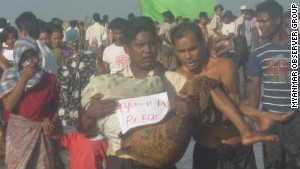
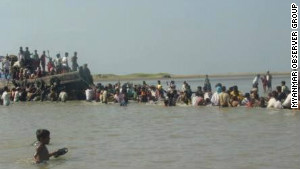
People have been displaced across Rahkine state in western Myanmar.
Some fled from the violence by boat
Hong Kong (CNN) -- The death toll from fighting between Buddhists and Rohingya Muslims in western Myanmar last week has risen to 84 and at least 22,500 people have been displaced by the sectarian violence, state media and the United Nations say.
The state-run New Light of Myanmar newspaper said on Monday that 129 people were also injured during the violence, which erupted on October 21 and has cast a pall over recent reforms in the Asian nation.
However, the paper added that no new clashes had been reported since Sunday and the areas affected had returned to "normalcy."
Following a visit to five townships where the fighting took place, Ashok Nigam, the U.N. humanitarian coordinator for Myanmar, on Sunday said his team had seen "large-scale" destruction of houses and the displaced were in urgent need of humanitarian assistance.
The swath of arson, the group said, stretched over 35 acres and included houseboats and floating barges. It added that local police shot at Muslims trying to put out the fires.
Phil Robertson, deputy Asia director of Human Rights Watch, said the government in Myanmar has done little to address the root causes of the violence and the discriminatory treatment that many Rohingya face.
"Extremists in both communities have been empowered by a lack of accountability where people involved in sectarian violence haven't been bought to justice so it's a very, very bad situation and one that is getting worse," he told CNN.
The Rohingya are a stateless Muslim minority who say they have been persecuted by the Myanmar military during its decades of authoritarian rule. Myanmar doesn't recognize them as citizens.
Unrest between the Rohingya and majority Buddhists has tested President Thein Sein's administration, which is trying to seek reconciliation with Myanmar's different ethnic groups and move the country toward more democratic governance.
The government has sent extra security into the troubled region and declared a state of emergency. The president's office warned Thursday that "manipulators" behind the violence can expect to be found and prosecuted.
Opposition leader Aung San Suu Kyi, speaking in Parliament on Friday, called for a greater security presence and urged authorities to investigate suspected human rights offenses.
The Burmese opposition leader begins her US visit with a meeting with the top American diplomat.
RFA
Aung San Suu Kyi (l) speaks with U.S.
Secretary of State Hillary Clinton (r) at the State Department in
Washington, Sept. 18, 2012.
Burma's opposition leader Aung San Suu Kyi opened her visit to
the United States with talks Tuesday with U.S. Secretary of State
Hillary Clinton on the welfare of Burmese refugees in America.
The
67-year-old Nobel laureate, who arrived on Monday for a nearly
three-week visit, met with Clinton at her office in the State
Department.
The top U.S. diplomat briefly spoke to Aung San Suu
Kyi on the resettlement of Burmese refugees in the United States and the
visitor's trip next week to Fort Wayne in Indiana state, home to a
large number of Burmese.
There is "so much excitement and
enthusiasm about the fact that you can actually come," Clinton told Aung
San Suu Kyi, according to journalists and photographers who were
allowed a couple of minutes to witness their meeting before they went
into closed talks.
Aung San Suu Kyi said she had heard about Fort
Wayne while tracking Burmese news when she was under house arrest for
nearly two decades during the rule of the previous military junta.
Since
2006, about 55,000 Burmese refugees, most whom were living in Thailand,
have been resettled in the United States. Many of them had fled nearly
five decades of harsh military rule and fighting between government
military troops and armed ethnic groups.
Aung San Suu Kyi will
take part later Tuesday in a Washington forum organized by the Asia
Society on the ongoing transition in Burma and the challenges facing the
country. Clinton will make introductory remarks at the event.
Landmark trip
Clinton
made a landmark trip to Burma nine months ago in the first visit by a
U.S. secretary of state in more than 50 years to begin reconciliation
with the nominally civilian government of President Thein Sein who took
over in March last year.
The two countries then named ambassadors
to each other's capitals, formalizing diplomatic relations for the
first time since Washington withdrew its ambassador in 1990.
The
United States also eased investment and financial restrictions to
reciprocate nascent reforms in Burma but said it will maintain an import
ban amid continuing human rights and ethnic conflict concerns.
The
Obama administration is believed to be considering easing a ban on
imports from Burma into the U.S., one of the main remaining sanctions
imposed on the country. The U.S. Congress last month renewed the ban for
another year.
Aung San Suu Kyi may also meet President Barack Obama during her trip, which is her first to the U.S. in 40 years.
The
White House has yet to announce whether she will meet Obama but sources
say he could hold talks with her despite his hectic re-election
campaign.
Just before Aung san Suu Kyi landed at the Dulles
airport in Washington Monday, Thein Sein ordered the release of another
514 prisoners, including dozens of political detainees, in an apparent
bid to pave the way for the U.S. to further ease sanctions ahead of his
trip to attend the U.N. meeting.
Aung San Suu Kyi is also
scheduled to attend a high-level meeting organized by U.N.
Secretary-General Ban Ki Moon, a day before Thein Sein addresses the
General Assembly, reports have said.
Reported by RFA's Burmese service. Written in English by Chris Billing and Parameswaran Ponnudurai.
Activists and rights groups are responding cautiously to Burma's latest
release of political prisoners, saying hundreds more are still being
held despite the government's promise to release them, Human Rights
Watch (HRW) said in a statement on Thursday.
Burmese President
Thein Sein's amnesty came a week before he travels to the US to attend
the United Nations General Assembly session. Human Rights Watch called
for governments to use the UN visit to press him to release all
remaining political prisoners and allow international monitors
unhindered access to Burma's jails.
The Burmese government this week released 514 prisoners, and activists estimate that around 90 were prisoners of conscience.
It
was the fourth amnesty declared in the past year by the Burmese
government, which has also eased press restrictions, allowed greater
political participation, and signed cease-fire deals with some rebel
groups.
But Human Rights Watch said the amnesty falls short of the president's commitment to release all political prisoners.
The
New York-based group called for independent monitors to be allowed into
Burmese prisons to determine how many political prisoners remain behind
bars.
Burmese democracy leader Aung San Suu Kyi on said Tuesday
that her party, the National League for Democracy, estimates there are
still 200 political prisoners behind bars. The Nobel laureate, currently
on a tour of the United States, said Burma cannot have real democracy
until all prisoners of conscience are released.
US Secretary of
State Hillary Clinton said on Tuesday that Burma still has “a lot of
work to do,” citing the political prisoners that remain in detention, as
well as ongoing communal unrest in Rakhine State and other ethnic areas.
United Nations special envoy to Burma Vijay Nambiar met with Burmese President Thein Sein on Thursday to discuss Rakhine State and a range of other topics, said the President's Office.
President Thein Sein received a delegation led by UNSG’s Special Adviser on Burma Vijay Nambiar at the Credentials Hall of the Presidential Palace on Friday, September 13, 2012. Photo: President's office
The talks focused on Burma-UN cooperation in providing assistance to riot victims in Rakhine State, including arrangements for advance aid teams representing Turkey, Indonesia, the United States and the Organization of Islamic Cooperation to assess the Rakhine situation.
Other topics included security and the rule of law being enforced in the state to prevent similar recurrences and arrangements for the rehabilitation of the victims.
Nambiar, a special adviser to UN Secretary-General Ban Ki-moon and UN Under-Secretary-General, is currently on his fourth visit to Burma.
The two sides also discussed socio-economic development projects including fulfilling the UN Millennium Goals.
President Thein Sein's upcoming attendance at the 67th UN General Assembly in New York, expected at the end of September, was also discussed.
Nambiar, an Indian diplomat who was appointed UN special envoy to Burma in 2010, has been Ban Ki-moon's chief of staff since January 2007.
(Bangkok) – Burmese security forces committed killings, rape, and
mass arrests against Rohingya Muslims after failing to protect both them
and Arakan Buddhists during deadly sectarian violence in western Burma
in June 2012. Government restrictions on humanitarian access to the
Rohingya community have left many of the over 100,000 people displaced
and in dire need of food, shelter, and medical care.
The 56-page report, “‘The Government Could Have Stopped This’: Sectarian Violence and Ensuing Abuses in Burma’s Arakan State,”
describes how the Burmese authorities failed to take adequate measures
to stem rising tensions and the outbreak of sectarian violence in Arakan
State. Though the army eventually contained the mob violence in the
state capital, Sittwe, both Arakan and Rohingya witnesses told Human
Rights Watch that government forces stood by while members from each
community attacked the other, razing villages and committing an unknown
number of killings.
“Burmese security forces failed to protect the Arakan and Rohingya from
each other and then unleashed a campaign of violence and mass roundups
against the Rohingya,” said Brad Adams, Asia director at Human Rights
Watch. “The government claims it is committed to ending ethnic strife
and abuse, but recent events in Arakan State demonstrate that
state-sponsored persecution and discrimination persist.”
The Burmese government should take urgent measures to end abuses by
their forces, ensure humanitarian access, and permit independent
international monitors to visit affected areas and investigate abuses,
Human Rights Watch said.
The “Government Could Have Stopped This,” is based on 57 interviews
conducted in June and July with affected Arakan, Rohingya, and others in
Burma and in Bangladesh, where Rohingya have sought refuge from the violence and abuses.
The violence erupted in early June after reports circulated that on May
28 an Arakan Buddhist woman was raped and killed in the town of Ramri
by three Muslim men. Details of the crime were circulated locally in an
incendiary pamphlet, and on June 3 a large group of Arakan villagers in
Toungop stopped a bus and brutally killed 10 Muslims on board. Human
Rights Watch confirmed that nearby local police and army stood by and
watched but did not intervene. In retaliation, on June 8 thousands of
Rohingya rioted in Maungdaw town after Friday prayers, killed an unknown
number of Arakan, and destroyed considerable Arakan property. Violence
between Rohingya and Arakan then swept through Sittwe and surrounding
areas.
Marauding mobs from both Arakan and Rohingya communities stormed
unsuspecting villages and neighborhoods, brutally killed residents, and
destroyed and burned homes, shops, and houses of worship. With little to
no government security present to stop the violence, people armed
themselves with swords, spears, sticks, iron rods, knives, and other
basic weaponry. Inflammatory anti-Muslim media accounts and local
propaganda fanned the violence. Numerous Arakan and Rohingya who spoke
to Human Rights Watch reached the conclusion that the authorities could
have prevented the violence and the ensuing abuses could have been
avoided.
A 29-year-old Arakan man and an older Rohingya man each told Human
Rights Watch, separately but in the same words, “The government could
have stopped this.”
The Burmese army’s presence in Sittwe eventually stemmed the
violence. However, on June 12, Arakan mobs burned down the homes of up
to 10,000 Rohingya and non-Rohingya Muslims in the city’s largest Muslim
neighborhood while the police and paramilitary Lon Thein forces opened
fire on Rohingya with live ammunition.
A Rohingya man in Sittwe, 36, told Human Rights Watch that an Arakan
mob “started torching the houses. When the people tried to put out the
fires, the paramilitary shot at us. And the group beat people with big
sticks.” Another Rohingya man from the same neighborhood said, “I was
just a few feet away. I was on the road. I saw them shoot at least six
people – one woman, two children, and three men. The police took their
bodies away.”
In Sittwe, where the population was about half Arakan and half Muslim,
most Muslims have fled the city or were forcibly relocated, raising
questions about whether the government will respect their right to
return home. Human Rights Watch found the center of the once diverse
capital now largely segregated and devoid of Muslims.
In northern Arakan State, the army, police, Nasaka border guard
forces, and Lon Thein paramilitaries have committed killings, mass
arrests, and other abuses against Rohingya. They have operated in
concert with local Arakan residents to loot food stocks and valuables
from Rohingya homes. Nasaka and soldiers have fired upon crowds of
Rohingya villagers as they attempted to escape the violence, leaving
many dead and wounded.
“If the atrocities in Arakan had happened before the government’s
reform process started, the international reaction would have been swift
and strong,” said Adams. “But the international community appears to be
blinded by a romantic narrative of sweeping change in Burma, signing
new trade deals and lifting sanctions even while the abuses continue.”
Since June, the government has detained hundreds of Rohingya men and
boys, who remain incommunicado. The authorities in northern Arakan State
have a long history of torture and mistreatment of Rohingya detainees,
Human Rights Watch said. In the southern coastal town of Moulmein, 82
fleeing Rohingya were reportedly arrested in late June and sentenced to
one year in prison for violating immigration laws.
“The Burmese authorities should immediately release details of
detained Rohingya, allow access to family members and humanitarian
agencies, and release anyone not charged with a crime recognized under
international law in which there is credible evidence,” Adams said.
“This is a test case of the government’s stated commitment to reform and
protecting basic rights.”
Burma’s 1982 Citizenship Law effectively denies Burmese citizenship
to the Rohingya population, estimated at 800,000 to 1 million people. On
July 12, Burmese President Thein Sein said the “only solution” to the
sectarian strife was to expel the Rohingya to other countries or to
camps overseen by the United Nations refugee agency.
“We will send them away if any third country would accept them,” he said.
Burmese law and policy discriminate against Rohingya, infringing on
their rights to freedom of movement, education, and employment. Burmese
government officials typically refer to the Rohingya as “Bengali,”
“so-called Rohingya,” or the pejorative “Kalar,” and Rohingya face
considerable prejudice from Burmese society generally, including from
longtime democracy advocates and ethnic minorities who themselves have
long faced oppression from the Burmese state.
Burma’s new human rights commission – led by chairman Win Mra, an
ethnic Arakan – has not played an effective role in monitoring abuses in
Arakan State, Human Rights Watch said. In a July 11 assessment of the
sectarian violence, the commission reported on no government abuses,
claimed all humanitarian needs were being met, and failed to address
Rohingya citizenship and persecution.
“The Burmese government needs to urgently amend its citizenship law
to end official discrimination against the Rohingya,” Adams said.
“President Thein Sein cannot credibly claim to be promoting human rights
while calling for the expulsion of people because of their ethnicity
and religion.”
The sectarian violence has created urgent humanitarian needs for both
Arakan and Rohingya communities, Human Rights Watch said. Local Arakan
organizations, largely supported by domestic contributions, have
provided food, clothing, medicine, and shelter to displaced Arakan. By
contrast, the Rohingya population’s access to markets, food, and work
remains dangerous or blocked, and many have been in hiding for weeks.
The government has restricted access to affected areas, particularly
Rohingya areas, crippling the humanitarian response. United Nations and
humanitarian aid workers have faced arrest as well as threats and
intimidation from the local Arakan population, which perceives the aid
agencies as biased toward the Rohingya. Government restrictions have
made some areas, such as villages south of Maungdaw, inaccessible to
humanitarian agencies.
“The authorities should immediately grant unfettered humanitarian
access to all affected populations and begin work to prevent future
violence between the communities,” Adams said. “The government should
assist both communities with property restitution and ensure all of the
displaced can return home and live in safety.”
Since the June violence, thousands of Rohingya have fled to neighboring
Bangladesh where they have faced pushbacks from the Bangladeshi
government in violation of international law. Human Rights Watch
witnessed Rohingya men, women, and children who arrived onshore and
pleaded for mercy from Bangladesh authorities, only to be pushed back to
sea in barely seaworthy wooden boats during rough monsoon rains,
putting them at grave risk of drowning or starvation at sea or
persecution in Burma. It is unknown how many died in these pushbacks.
Those who were able to make it into Bangladesh live in hiding, with no
access to food, shelter, or protection.
Bangladesh is obligated to open its borders and provide the Rohingya at
least temporary refuge until it is safe for them to return, in
accordance with international human rights norms. Human Rights Watch
called on concerned governments to assist Bangladesh in doing so and
press both Burma and Bangladesh to end abuses and ensure the safety of
Rohingyas.
“Bangladesh is violating its international legal obligations by
callously pushing asylum seekers in rickety boats back into the open
sea,” Adams said.
Accounts From “The Government Could Have Stopped This”
“We discussed it and decided to burn down some [Rohingya]
villages that all the Muslims used as a headquarters. For example, Narzi
and Bhumi. We first started to set fire to Bhumi village, the
headquarters of the Muslim people. We burned down the houses and then
they burned down ours. In some areas, we did not burn down houses. It
would have been foolish in some areas where most houses are near Arakan
houses. They would all catch fire. It was a three-day offensive. It
started near Bhumi village near Sittwe University because Bhumi is their
headquarters.”
– Arakan man, 45, Sittwe, Arakan State, June 2012
“The first Muslim people [who arrived] used guns. At that time, we
heard the shooting and my husband tried to attack the Muslim people.
They killed him right there in the village. His arm was cut off and his
head was nearly cut off. He was 35 years old.”
– Arakan mother of five children, 31, Sittwe, Arakan State, June 2012
“I fell down and couldn’t breathe I was so scared. I saw all the
violence. Around 300 Muslims came to attack our village. They came and
burned the houses. I saw them burning the houses.... The police did not
come during the violence. When the Muslims came and burned the village, I
fled. It was not until I got to Sittwe that I saw any police.”
– Arakan woman, 40, Sittwe, Arakan State, June 2012
“In front of my eyes, first the Lon Thein [paramilitaries] came and
said they came to protect us, but when the Arakan came and torched the
houses, we tried to put out the fires and they started beating us. A lot
of people were shot [by the police] at a close distance. I saw people
get shot at close range. The whole village witnessed it. They were
people from my village. They were 15 or 20 feet away from me.... I saw
at least 50 people killed.... When we tried to go put out the fire, we
were not allowed to go. First they shot once in the air, and then at the
people.”
– Rohingya man, 28, Sittwe, Arakan State, June 2012
“The government did not return the dead bodies to our family. They took
them and cremated them in the monastery. I did not get the bodies of my
two brothers-in-law.... They were killed by the Arakan in front of me.
The police were there. It was not far from the police. They were killed
in front of me and the police did nothing.”
– Rohingya man, 65, Sittwe, Arakan State, June 2012
North American Muslim Foundation (NAMF) has called
for urgent action to halt killings, rapes and expulsions being carried
out in western Burma against ethnic Rohingya (Muslim) Burmese citizens.
In a press statement on Aug 4, NAMF condemn the attack and brought to
the attention of the issue of the current genocide of fellow Muslims in
Burma. It said that the United Nations calls them as -one of the most
persecuted minorities of the world.- Most recently, over 1000 Rohingya
Muslims were killed, 1,200 plus are missing and more than 100,000 have
been displaced due to rape, arson and killing. 1,336 homes belonging to
the Rohingya Muslims have been burnt to ashes during the recent unrest.
It further said that, the Burmese military government, far from trying
to resolve the problem and protecting the Rohingya, has been silently
convening with the rioters to add to their plight and suffering. This
atrocity must stop now
In order to avoid the worsening of the situation NAMF demanded the
Canadian government to take urgent action in addressing this issue with
the UN Security Council in order to pressure the Burmese government to
stop all atrocities.
NAMF also demanded International relief organizations to be allowed to
provide immediate access and humanitarian aid to the victims.
NAMF demanded the Ministry of Canadian Foreign Affairs to put pressure
on the Bangladeshi government to open its borders to the fleeing Burmese
refugees who are in dire need of aid and protection.
"We request all Canadians to protest against the Burmese state-sponsored
oppression against the Rohingya and strongly denounce all acts of
cruelty against them", it added.